19 listed liquor companies lost nearly RMB 10 billion in combined half-year profits, and the entire industry is hunkering down for winter. But one distiller has chosen to do exactly the opposite – while others cut budgets, it upgraded its entire product line; while others retrenched, it pushed into 10,000 convenience stores. To understand Gujing Gongjiu’s semi-annual report, the key lies not in the numbers themselves, but in what lies beyond them.
On August 28, Gujing Gongjiu (000596.SZ) released its 2026 semi-annual report. In the third year of the baijiu industry’s deep adjustment, the data in this financial report appears unremarkable. But what truly deserves attention is never the numbers themselves – it is the series of “counter-cyclical” moves that Gujing Gongjiu has been making behind those numbers.
Using an economic concept to understand what Gujing Gongjiu is doing
Let’s introduce an economic concept first: Countercyclical Investment. This concept has many classic examples in business history. During the 1997 Asian financial crisis, Samsung Electronics increased its semiconductor R&D investment against the trend, eventually surpassing Japanese companies to become the global leader in memory chips. During the 2008 global financial crisis, Netflix went all-in on streaming technology while competitors were retrenching, completing its transformation from a DVD rental service to a streaming giant.
The core logic of countercyclical investment is simple: when an industry enters a contraction phase, most companies choose to cut budgets, preserve cash, and endure the winter. But countercyclical players choose to sow seeds when others are fearful, building capabilities when costs are at their lowest. When spring arrives, others are just waking up, but you are already standing on higher ground.
In the view of JiuYe Times, Gujing Gongjiu’s series of moves in 2026 represent a textbook case of countercyclical investment. The “contraction” seen in the financial statements is precisely what creates space for strategic “expansion.”
Placing Gujing Gongjiu in the industry context
First, the industry panorama. In the first half of 2026, with the exception of Shanxi Fenjiu, the 19 listed baijiu stocks generated combined revenue of RMB 179.4 billion, a decrease of RMB 9.7 billion year-on-year; combined net profit attributable to shareholders was RMB 67.4 billion, a decrease of RMB 9.5 billion year-on-year. Of these 19 companies, only five – Kweichow Moutai, Wuliangye, Yingjia Gongjiu, Jinhui Liquor, and ZJLD – achieved revenue growth, while the remaining 14 all saw declines.
The sub-premium tier has been particularly pressured. Luzhou Laojiao’s first-half revenue was RMB 10.472 billion, down 36.35% year-on-year, with net profit attributable to shareholders of RMB 4.339 billion, down 43.37%; Yanghe Co. had revenue of RMB 10.540 billion, down 28.76%, and net profit of RMB 2.602 billion, down 40.1%; Shede Liquor’s revenue was RMB 2.287 billion, down 15.34%, with net profit plummeting 67.26% to RMB 145 million; Kouzi Distillery’s revenue was RMB 1.952 billion, down 22.9%, with net profit plummeting 49% to RMB 365 million.
Gujing Gongjiu recorded revenue of RMB 10.131 billion and net profit attributable to shareholders of RMB 2.164 billion. Within the sub-premium cohort, Gujing Gongjiu’s scale remains firmly among the top tier. More noteworthy is the quality of its earnings. Gujing Gongjiu’s liquor business gross margin stood at 80.63%, ranking among the top in the industry. Within this, the Vintage Pulp series achieved a gross margin as high as 85.03%. Amid the industry-wide price wars, maintaining a gross margin above 80% means that pricing power and brand premium for core products remain intact.
There is another easily overlooked highlight: online channel revenue of RMB 658 million, up 14.92% year-on-year. Against the backdrop of weakening offline sell-through across the industry, sustained growth in online channels has opened a second growth curve for Gujing Gongjiu.
In 2026, Gujing Gongjiu quietly undertook several “counter-seasonal” moves
If the baijiu industry were compared to the four seasons, 2026 is undoubtedly winter. But Gujing Gongjiu has chosen this winter to do several things that go against the season.
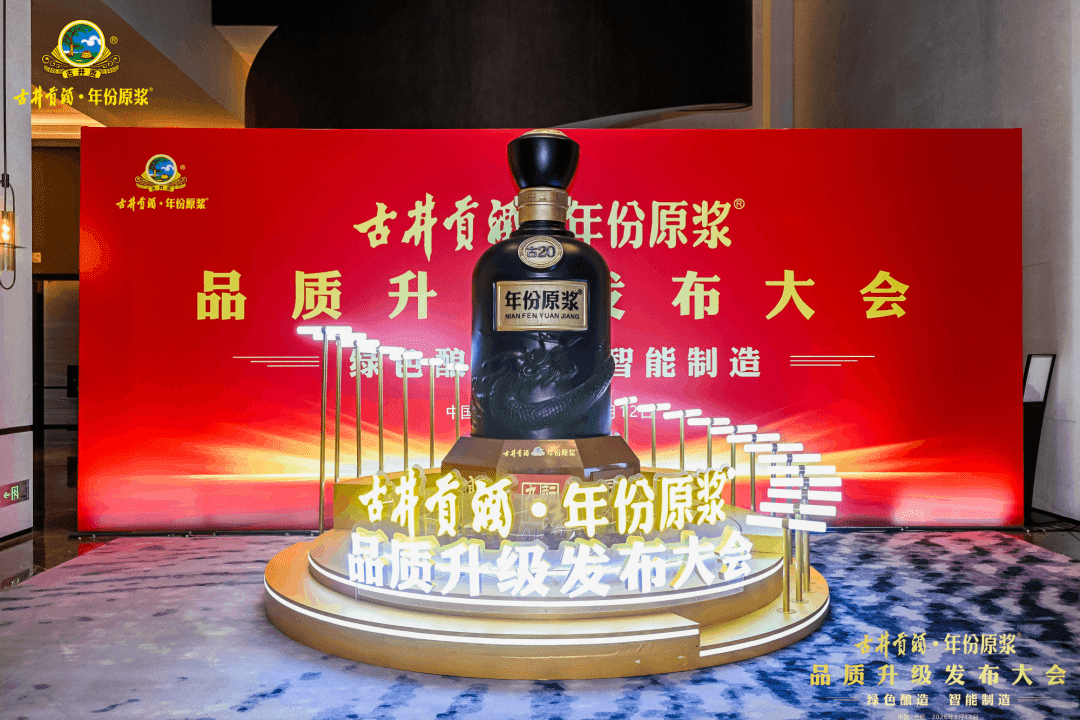
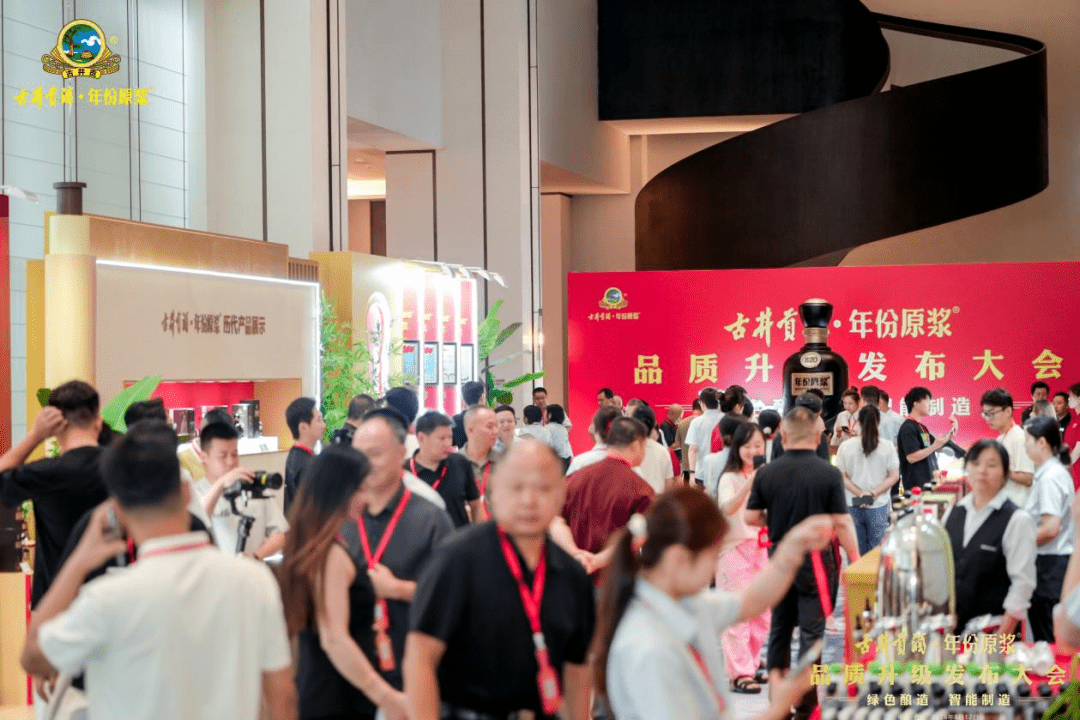
The first: a full-series quality upgrade – “quality improved, price unchanged.” On August 12, the Gujing Gongjiu · Vintage Pulp Quality Upgrade Launch Conference was held in Hefei, announcing a systematic upgrade of the liquor bodies across the entire Vintage Pulp series – Gift Edition, Gu 5, Gu 7, Gu 8, Gu 16, and Gu 20. The breadth and intensity of this upgrade are rare in the baijiu industry in recent years. For this upgrade, the R&D team spent six months visiting over 100 retail outlets, collecting 148 pieces of consumer taste feedback, and completing over 1,000 batches of base liquor analysis and more than 200 groups of liquor body design experiments. Product samples underwent multiple rounds of blind testing – “not just what the professional tasters say is good, but what consumers say is good.”
Even more critical is the strategy: “quality improved, price unchanged.” Under the industry’s prevailing logic that “upgrades must come with price increases,” Gujing Gongjiu has chosen to pass the quality dividend directly to consumers. This is essentially a countercyclical investment in brand equity – building differentiated barriers through product strength at the very moment when industry price wars are most intense.
The second: signing Louis Koo as brand ambassador, executing a “cross-cycle allocation” of brand assets. On the same day, Gujing Gongjiu announced the appointment of renowned actor Louis Koo as its brand ambassador. With over three decades in the entertainment industry and a Hong Kong Film Award for Best Actor, Koo’s public image of “low-key, dedicated, and constantly striving for excellence” closely aligns with Gujing Gongjiu’s corporate values of “being true, brewing fine liquor, cultivating oneself, and benefiting the world.”
In the view of JiuYe Times, brand endorsement is essentially a form of “cross-cycle asset allocation” – during industry downturns, endorsement fees are more reasonable, the communications environment is cleaner, and the brand’s voice is more likely to be heard. The pun “Drink Gujing, Enjoy Every Day” quickly went viral on social platforms, achieving efficient brand awareness diffusion within a low-cost window.
The third: Light series + convenience stores – using a “small entry point” to leverage a “big market.” In March, Gujing Gongjiu launched the 26-degree “Vintage Pulp Light Gu 7 and Light Gu 8,” positioned for “lightweight, light social, light living.” The earlier-launched Light Gu 20 saw orders exceed 500,000 bottles in its first month on the market. On August 22, Gujing Gongjiu reached strategic partnerships with 11 leading convenience store brands including Linji, Meiyitian, and Yidu, jointly launching two exclusive channel products – “Gujing Daqu” (RMB 19.9) and “Shenli Jiu Youth Edition” (RMB 14.9) – covering over 100 cities and more than 10,000 retail terminals across 12 provinces.
This is not a simple distribution push, but a systematic restructuring of consumption scenarios – extending from traditional banquet and gifting occasions to everyday solo drinking and self-pleasure light consumption scenarios. Convenience stores’ advantages of proximity to communities, business districts, and office areas, combined with 24-hour operations and instant delivery capabilities, perfectly match the direction of baijiu’s everyday consumption trend.
The logic underlying this series of moves is clear: secure the core business through quality upgrades, expand into new circles through brand elevation, and enter new scenarios through product innovation. Each move is a countercyclical investment – requiring short-term expenditure while building long-term barriers.
The market’s “vote”
On the day of the earnings release, Gujing Gongjiu’s share price closed up 1.88%, with market capitalisation stable at RMB 49.6 billion. Following the company’s 2025 annual report, China Merchants Securities had already noted that the company had “significantly cleared its books to relieve channel pressure.” Multiple institutions believe that as signs of industry bottoming emerge, Gujing Gongjiu’s operational trough is being consolidated.
The baijiu industry’s adjustment continues, but Gujing Gongjiu is no longer a company waiting for spring to arrive – it has already planted its seeds in winter.