8月18日,舍得酒业2026年半年报出炉。上半年营收22.87亿元,同比下滑15.34%;归母净利润1.45亿元,同比下滑67.26%。二季度单季亏损8641.34万元。
次日开盘,舍得股价盘中一度跌超2.6%,随后收窄至2.28%,报35.21元/股。没有恐慌性抛售,没有跌停,甚至连一篇像样的“看空”研报都没见到。
市场对这份“史上最差”半年报的反应,平淡得像一杯温吞水。
在酒业时报看来,这恰恰说明一件事:白酒行业最糟糕的消息,已经被市场充分消化了。
不是舍得的“独奏”,是整个行业的“合唱”
先别急着盯舍得一家。把视角拉远一点。
截至7月中旬,17家披露上半年业绩预告的上市酒企中,10家亏损、4家盈利腰斩。金种子酒亏损6000万至7200万元。水井坊时隔多年报出半年度亏损,预计亏损622.21万元。皇台酒业预计亏损1000万至1800万元,时隔两年再次半年度亏损。贵州茅台也出现了25年来第二次中期净利下滑。
今世缘半年报营收64.35亿元,同比下降7.41%;净利润20.82亿元,同比下降6.60%。华润啤酒的白酒业务(金沙酒业)上半年营业额仅5.7亿元,同比下滑约27%。
中国酒业协会发布的《2026中国白酒市场中期研究报告》指出,超86%的调研企业利润下滑,68.5%的企业预期下半年继续下行。行业正经历典型的“量价利三杀”。
舍得二季度亏损8641万元,水井坊亏损622万元——数字不同,但故事是同一个:白酒行业仍在深度调整的隧道里,还没有看到出口的光。

市场为什么不慌了?因为“意外”才是恐慌的源头
舍得这份半年报真正让市场“无感”的原因,是它毫无意外。
早在7月10日,舍得就发布了业绩预减公告,预计上半年归母净利润1.35亿元至1.75亿元,同比减少69.55%至60.52%。最终1.45亿元的实际数字,稳稳落在预告区间之内。
预期之内,就是利好。
更重要的是,白酒板块的悲观预期在股价中早已充分反映。有机构指出,白酒行业当前处于L型弱复苏底部,板块机构持仓已降至低位,基本面现状和悲观情绪大概率已反馈在前期股价中。当一只股票已经把最坏的消息“跌完了”,再坏的消息也不再是坏消息。

“控量挺价”:短期止痛还是长期用药?
回到舍得自身。财报给出的业绩下滑解释是:主动实施“控量挺价”策略,适度控制发货,支持经销商消化库存。
这个解释,市场买账吗?
部分买账。从单季数据看,二季度经营性现金流净流入7540万元,较一季度明显改善,合同负债1.61亿元,较一季度末增加超3000万元。渠道的“水”在往回蓄,这是好事。
不过,若拉通上半年整体来看,经营活动产生的现金流量净额为-2658.37万元,同比下滑139.46%。二季度的改善尚未完全扭转上半年的整体流出态势,现金流“回正”仍需时间验证。
硬币的另一面同样清晰。上半年销售费用5.86亿元,同比增长2.52%,占营收比重25.64%。二季度销售费用率同比增加10个百分点至33.7%。一边是收入端主动收缩,一边是费用端刚性支出,利润被两头挤压,二季度净利率降至-11%。
白酒专家肖竹青的评价颇为中肯:这属于“牺牲短期报表数据,以换取渠道长期健康的操作”,是“理性的长期主义选择”。
在酒业时报看来,“控量挺价”是必要的止痛药,但它治的是“渠道库存过高”这个症状,而不是“需求萎缩”这个病因。当整个行业的消费需求在收缩,控量只是让疼痛减轻了一些,并没有改变病根。

产品结构的下移:被动适配还是主动破局?
半年报中最值得深挖的信号,藏在产品结构里。
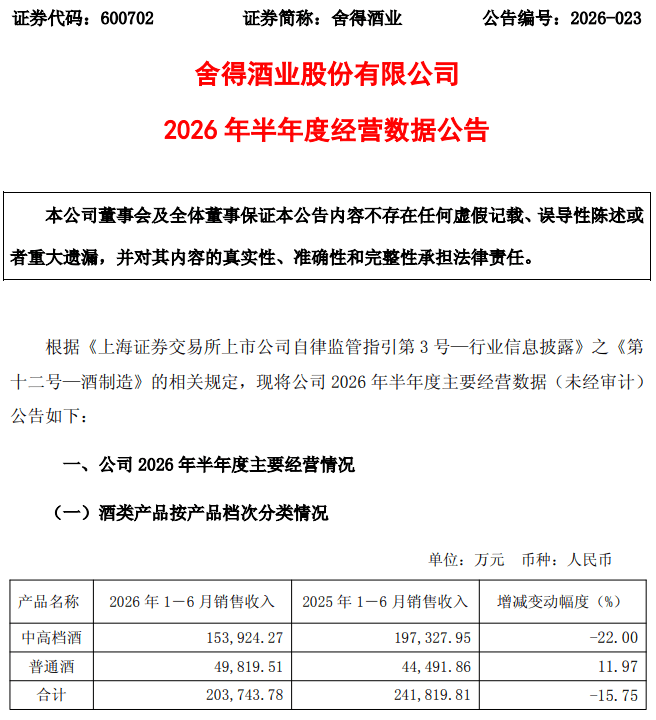
中高档酒收入15.39亿元,同比下滑22%;普通酒收入4.98亿元,同比增长11.97%。
这是一组充满矛盾的数据。大众价位产品在涨,说明消费降级的趋势确实存在,沱牌T68、舍之道等产品正在承接“喝少一点、喝好一点”但“不喝那么贵”的消费需求。但中高档酒的持续萎缩,意味着舍得最核心的利润来源——品味舍得、智慧舍得等次高端大单品——仍在承压。
华泰证券研报判断,当前环境下品味系列仍略有压力。华鑫证券数据显示,产品结构变化导致二季度毛利率同比减少8.8个百分点至51.8%。
省外市场同样不容乐观。上半年省外收入同比下滑21.89%,二季度单季下滑34.2%。川内市场相对稳健,上半年仅下滑2.92%,但二季度也扩大至18.3%的降幅。
大众酒在涨、省内在稳——但这些“对冲项”的体量,远远弥补不了中高档和省外的缺口。舍得目前的状态,更像是在行业下行中“被动适配”,而不是已经找到了主动破局的新路径。

从“压货冲量”到“管理预期”:一场根本性的思维转变
过去二十年,白酒行业习惯了“压货-涨价-业绩增长”的简单循环。经销商打款、酒企发货、报表好看——这套逻辑在增量时代屡试不爽。
但在存量甚至缩量的时代,这套逻辑失效了。
中国酒业协会报告显示,74.8%的受访企业营业额萎缩,61.9%的终端门店减少,56.6%的经销商反映价格倒挂程度同比加剧。当整个渠道都“塞满了”,继续压货只会把问题越滚越大。
在酒业时报看来,舍得真正的挑战不在于“控量挺价”这个战术动作本身,而在于——传统的政策工具和市场手段已经不足以应对当前的困局了。控量、控价、加大费用投入、优化经销商——这些工具在行业上行期是放大器,在下行期却只是减速器。
真正能穿越周期的,是对市场预期的主动管理。
舍得在这方面并非没有动作。2026年以来,公司持续强化与资本市场的沟通——3月举行投资者关系活动,4月召开业绩说明会。在渠道端推进“青年创业计划”培育年轻经销商。在品牌端建立品牌营销项目沟通机制。这些动作的意义,超越了传统的“投资者关系”范畴——在行业底部,市场最缺的不是业绩数字,而是“确定性”:对企业战略方向的确定性,对管理层执行力的确定性,对行业何时见底的确定性。

中秋:检验“底部成色”的第一块试金石
券商的态度整体偏谨慎乐观。华泰证券维持“买入”,认为当前次高端需求依然偏弱,但公司主动坚持“稳价格、控库存、强动销”原则。平安证券维持“推荐”,预计2026-2028年归母净利润分别为2.3/2.7/3.1亿元。也有机构给出“中性”评级,预计2027年目标价37.24元。
分歧在于节奏,共识在于方向——调整还在继续,但最坏的时候可能正在过去。
即将到来的中秋国庆旺季,将是检验这轮调整“成色”的第一块试金石。终端动销能否回暖、核心产品批价能否企稳、渠道库存能否进一步出清——这三个指标,比任何一份财报都更能说明问题。
当市场不再为一份亏损的财报感到意外,底部可能真的不远了。但“不远”不等于“已到”,从底部到反弹,中间还隔着无数个中秋和国庆。
On August 18, Shede Liquor released its 2026 semi-annual report. First-half revenue reached RMB 2.287 billion, down 15.34% year-on-year; net profit attributable to shareholders was RMB 145 million, down 67.26% year-on-year. In the second quarter alone, the company recorded a loss of RMB 86.41 million. At the opening of trading the following day, Shede’s share price fell more than 2.6% intraday, before narrowing to a 2.28% decline, closing at RMB 35.21 per share. No panic selling, no limit-down, not even a single bearish research report of any substance. The market’s response to this “worst-ever” semi-annual report was as tepid as a glass of lukewarm water.
In the view of JiuYe Times, this precisely demonstrates one thing: the worst news for the baijiu industry has already been fully priced in by the market.
Not Shede’s “Solo” – The Entire Industry’s “Chorus”
Before rushing to focus on Shede, take a step back. As of mid-July, among the 17 listed liquor companies that disclosed first-half earnings guidance, 10 reported losses and 4 saw profits halved. Jinzhongzi reported a loss of RMB 60 million to RMB 72 million. Shuijingfang posted its first half-year loss in years, with an expected loss of RMB 6.22 million. Huangtai Liquor forecast a loss of RMB 10 million to RMB 18 million – its first half-year loss in two years. Kweichow Moutai also recorded its second mid-year profit decline in 25 years. Jinshiyuan’s half-year revenue was RMB 6.435 billion, down 7.41% year-on-year; net profit was RMB 2.082 billion, down 6.60%. China Resources Beer’s liquor business (Jinsha Liquor) recorded first-half turnover of only RMB 570 million, down approximately 27% year-on-year.
The China Alcoholic Drinks Association’s 2026 China Baijiu Market Mid-Year Report noted that over 86% of surveyed enterprises saw profit margins decline, with 68.5% expecting the industry to continue its downward trend in the second half. The industry is experiencing a classic “triple whammy” of declining volume, price, and profit. Shede’s Q2 loss of RMB 86.41 million, Shuijingfang’s loss of RMB 6.22 million – the numbers differ, but the story is the same: the baijiu industry remains deep in the tunnel of adjustment, with no light yet visible at the exit.
Why Isn’t the Market Panicking? Because “Surprise” Is the Source of Panic
The real reason the market reacted with indifference to Shede’s semi-annual report is that it contained no surprises. As early as July 10, Shede had already issued a profit warning, forecasting first-half net profit attributable to shareholders of between RMB 135 million and RMB 175 million, a year-on-year decline of 69.55% to 60.52%. The actual final figure of RMB 145 million landed squarely within the forecast range. When results are within expectations, that is good news.
More importantly, the pessimistic outlook for the baijiu sector has long been fully reflected in share prices. Some institutions have pointed out that the baijiu industry is currently at the bottom of an L-shaped weak recovery, with institutional holdings in the sector already at low levels. The fundamental reality and pessimistic sentiment have likely already been priced into previous share price movements. When a stock has already “priced in” the worst possible news, even bad news ceases to be bad.
“Volume Control and Price Support”: A Short-Term Painkiller or Long-Term Medicine?
Turning back to Shede itself. The earnings report attributed the performance decline to the proactive implementation of a “volume control and price support” strategy – moderating shipment volumes and supporting distributors in digesting inventory. Does the market buy this explanation?
Partly, yes. Looking at the quarterly data, operating cash flow in Q2 saw a net inflow of RMB 75.4 million, a marked improvement from Q1. Contract liabilities reached RMB 161 million, an increase of over RMB 30 million from the end of Q1. The channel is slowly refilling – this is a positive sign. However, looking at the first half as a whole, net cash flow from operating activities was -RMB 26.58 million, down 139.46% year-on-year. The Q2 improvement has not yet fully reversed the overall outflow trend for the first half, and a return to positive cash flow still needs time to materialise.
The other side of the coin is equally clear. First-half selling expenses reached RMB 586 million, up 2.52% year-on-year, accounting for 25.64% of revenue. In Q2, the selling expense ratio increased by 10 percentage points year-on-year to 33.7%. With revenue shrinking on one side and fixed expenses on the other, margins were squeezed from both ends, pushing the Q2 net margin into negative territory at -11%.
Baijiu expert Xiao Zhuqing offered a measured assessment: this is “an operation that sacrifices short-term financial performance for long-term channel health,” a “rational long-termist choice.” In the view of JiuYe Times, “volume control and price support” is a necessary painkiller, but it treats the symptom of “excess channel inventory” rather than the root cause of “shrinking demand.” When industry-wide consumer demand is contracting, volume control only alleviates the pain – it does not change the underlying condition.
Downward Shift in Product Mix: Passive Adaptation or Proactive Breakthrough?
The most significant signal worth exploring in the semi-annual report lies in the product mix. Mid-to-high-end liquor revenue reached RMB 1.539 billion, down 22% year-on-year; ordinary liquor revenue reached RMB 498 million, up 11.97% year-on-year. These are contradictory figures.
The mass-market segment is growing, confirming the trend of consumption downgrading. Products like Tuopai T68 and Shezhidao are capturing demand for “drinking less, drinking better” but “not drinking as expensively.” However, the continued contraction of mid-to-high-end products means Shede’s core profit drivers – sub-premium mega-brands like Pinwei Shede and Zhihui Shede – remain under pressure. Huatai Securities research suggests that the Pinwei series is still facing some headwinds in the current environment. Huaxin Securities data shows that the shift in product mix caused Q2 gross margin to decline by 8.8 percentage points year-on-year to 51.8%.
The provincial market is also far from optimistic. First-half provincial revenue fell 21.89% year-on-year, with Q2 alone declining 34.2%. The Sichuan market remained relatively stable, with only a 2.92% decline in the first half, though Q2 also saw the decline widen to 18.3%. Mass-market products are growing, the home market is stable – but the scale of these “offsets” is far from enough to compensate for the shortfall in mid-to-high-end products and provincial markets. Shede’s current state appears more like “passive adaptation” in a downturn rather than having found a proactive path to breakthrough.
From “Inventory Loading and Volume Chasing” to “Managing Expectations”: A Fundamental Shift in Thinking
Over the past two decades, the baijiu industry has become accustomed to the simple cycle of “inventory loading – price increases – performance growth.” Distributors pay upfront, distilleries ship goods, financial statements look good – this logic worked flawlessly in the era of growth. But in the era of stagnant or even shrinking markets, this logic no longer applies. The China Alcoholic Drinks Association report shows that 74.8% of surveyed enterprises saw revenue shrink, 61.9% reduced their retail outlets, and 56.6% of distributors reported worsening price inversions year-on-year. When the entire channel is “stuffed full,” continuing to push inventory only compounds the problem.
In the view of JiuYe Times, Shede’s real challenge is not the tactical move of “volume control and price support” itself, but rather the fact that traditional policy tools and market measures are no longer sufficient to address the current predicament. Volume control, price management, increased expense investment, distributor optimisation – these tools are amplifiers in an up-cycle, but only decelerators in a downturn. What truly enables a company to transcend cycles is the proactive management of market expectations.
Shede has not been idle on this front. Since the start of 2026, the company has continuously strengthened communication with the capital market – holding investor relations events in March and a performance briefing in April. On the channel side, it has promoted the “Youth Entrepreneurship Programme” to cultivate young distributors. On the brand side, it has established a brand marketing project communication mechanism. The significance of these moves goes beyond traditional “investor relations” – at the bottom of the industry cycle, what the market needs most is not performance figures, but “certainty”: certainty about the company’s strategic direction, certainty about management’s execution capability, and certainty about when the industry will bottom out.
Mid-Autumn Festival: The First Litmus Test for the “Bottom”
Brokerage sentiment is generally cautiously optimistic. Huatai Securities maintains a “Buy” rating, believing that although current sub-premium demand remains weak, the company is proactively adhering to the principles of “stable prices, inventory control, and sell-through strengthening.” Ping An Securities maintains a “Recommend” rating, projecting net profit attributable to shareholders of RMB 230 million, RMB 270 million, and RMB 310 million for 2026–2028 respectively. Some institutions have given a “Neutral” rating, with a 2027 target price of RMB 37.24. The divergence lies in timing, but the consensus lies in direction – adjustment is still ongoing, but the worst may be passing.
The upcoming Mid-Autumn Festival and National Day peak season will be the first true test of this adjustment’s depth. Whether terminal sell-through can recover, whether core product wholesale prices can stabilise, and whether channel inventory can be further cleared – these three indicators will reveal more than any earnings report.
When the market no longer expresses surprise at a loss-making earnings report, the bottom may truly be near. But “near” is not “here” – between the bottom and a rebound lie countless Mid-Autumn Festivals and National Days.
原创文章版权归本网所有;转载文章归原作者所有。发布者:酒业时报,转载请注明出处:https://www.thewinetimes.com/gongsi/11980