光瓶酒赛道正经历有史以来最滚烫的行情。据行业机构测算,光瓶酒市场规模突破2100亿元,同比实现两位数增长,是白酒大盘里为数不多维持双位数增长的细分赛道。50100元的高线光瓶酒更是凶猛,增速直接拉到40%以上。
然而,就在这种“泼天富贵”的行情里,昔日的“光瓶酒之王”牛栏山,交出的半年报却像一盆冰水。
顺鑫农业8月21日晚间披露的2026年半年报显示,公司上半年营收38.04亿元,同比下降17.17%;净利润4035万元,同比暴跌76.66%。其中,以牛栏山为主的白酒产业实现营收28亿元,同比减少22.33%。
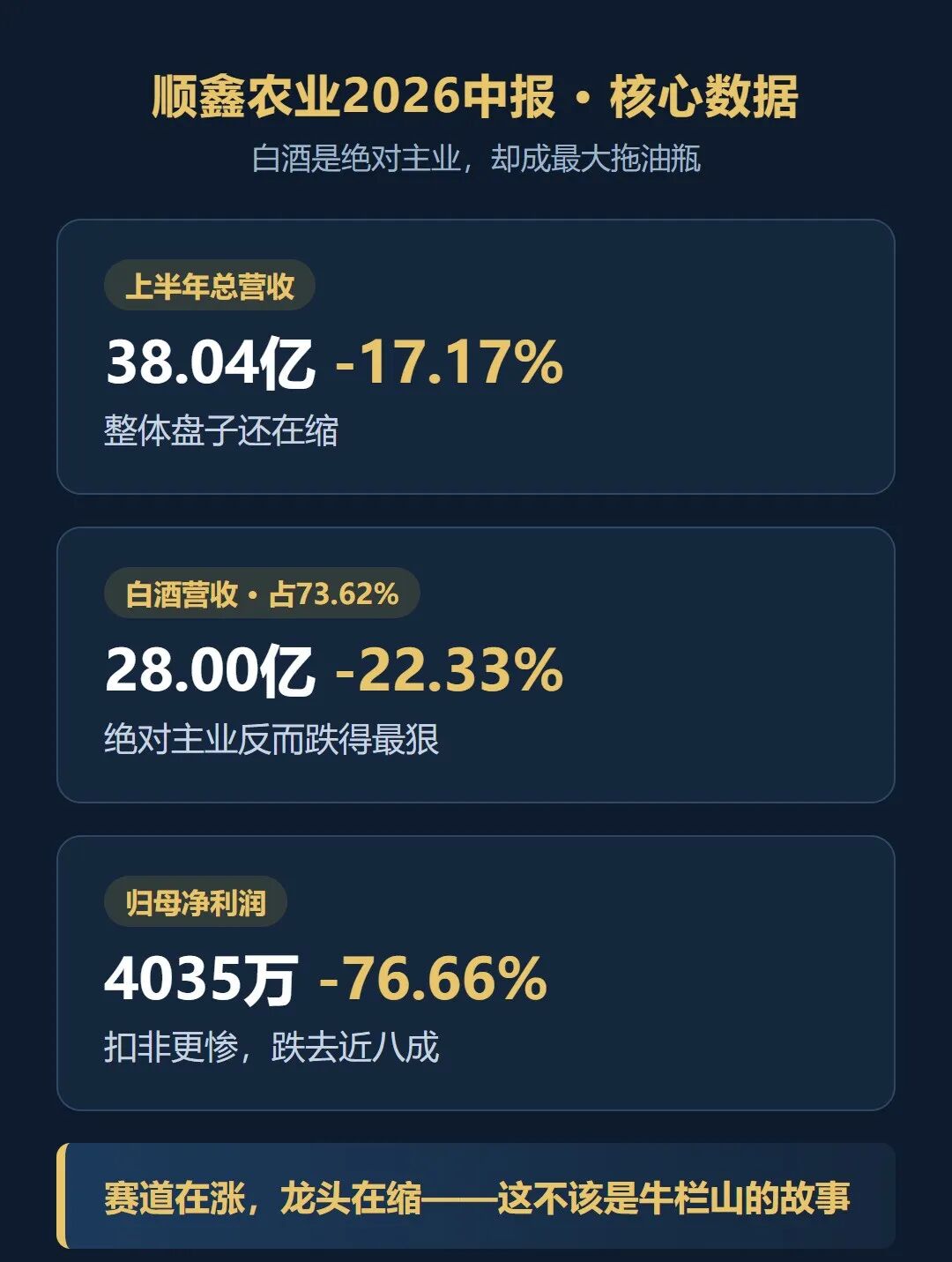
行业在烈火烹油,牛栏山却如坠冰窟。这已不是简单的掉队,而是一场长达五年的“慢性失血”——从2021年白酒业务破百亿的巅峰,到如今半年仅28亿,牛栏山用五年时间,跌没了半个自己。
百亿帝国的底盘,为何被悄悄抽空?
复盘牛栏山的坠落,不能简单归咎于某一次战略失误。它的困境,是旧时代王者遇上新时代规则的经典样本。
牛栏山过去称霸光瓶酒的核心武器,是“极致性价比”和遍布全国的毛细血管渠道。十几块钱的“白牛二”,是无数底层务工者和老酒友的口粮,巅峰时年销超8亿瓶。这种规模效应构筑的护城河,曾让所有对手望尘莫及。
但成也规模,败也规模。当2022年白酒新国标落地,对“配制酒”和“白酒”做出严格区隔时,白牛二“液态法白酒”的身份被置于聚光灯下。尽管牛栏山紧急推出纯粮酿造的“金标陈酿”救场,但一个旧帝国的转身,远比想象中笨重。
更关键的是,在牛栏山忙于应付标准切换的这五年,光瓶酒市场的底层驱动力已彻底切换——从“价格导向”转向了“价值导向”。消费者不再是只要便宜就行,而是开始看香型、看年份、看是否纯粮固态。
在酒业时报看来,牛栏山最大的敌人不是玻汾,也不是红星,而是一个正在快速觉醒并走向分化的消费时代。当“喝少点、喝好点”成为共识,牛栏山庞大的低端基本盘就成了最不坚固的城池。
大单品老化:“白牛二”失速与“金标”折戟
直接反映在经营数据上,就是核心大单品的全面承压。
上半年,扛鼎之作“白牛二”销量仍超10万千升,但同比下滑10.07%。下滑本身并不可怕,可怕的是库存数据暴露出的渠道信心危机——52度500ml牛栏山陈酿的库存同比激增221.25%。低度产品还能靠惯性走量,高度产品已出现严重的渠道堵塞,经销商打款意愿在减弱。
而曾被公司寄予厚望、对标3040元价格带的纯粮战略单品“金标陈酿”,表现更令人担忧。财报显示其销量下滑幅度高达72.23%。这款2022年推出、承载着牛栏山“纯粮转型”全部希望的产品,据行业调研,年均销量甚至不及目标的一半。
一面是基本盘产品被新国标和竞品夹击,一面是升级产品在终端不被买账。牛栏山卡在了“上下不能”的尴尬地带:向上,在50元价格带,品牌力不如玻汾、红星蓝瓶等名酒嫡系;向下,在15元价格带,又面临区域杂牌和散酒的残酷价格战。
2100亿赛道的新规则:从“草莽江湖”到“名酒修罗场”
如果说过去的牛栏山是“光瓶酒大王”,那么现在的光瓶酒赛道,已是名酒企的修罗场。
茅台台源布局156元价位,五粮液尖庄固守5070元,泸州老窖黑盖卡位6080元,玻汾更是以年销2亿瓶、逼近90亿规模的体量,成为高线光瓶的绝对王者。湘财证券一份研报推演,若玻汾市占率从当前的6%对标牛栏山巅峰期14%的水平,其规模空间可突破200亿元。
这是一场对存量市场赤裸裸的瓜分。光瓶酒的市场结构,正从“纺锤型”被生生挤成“哑铃型”。要么在超低价位用极致成本走量,要么在高线价位用名酒品牌收割。而牛栏山曾经最擅长的“中间地带”,正被这两个极端力量撕扯得支离破碎。
值得玩味的是,中东主权财富基金阿布达比投资局的操作颇具信号意义。该机构于2024年三季度新进成为顺鑫农业前十大流通股东,并在2025年四季度逆势增持至约1120万股。然而,2026年一季度它便大幅减持519.99万股,至半年报时已彻底从前十大名单中消失。资本的嗅觉最灵敏,它们的离场,或许比财报数字更能说明问题。
至暗时刻里的微光:二季度企稳与毛利改善
当然,在一片肃杀中,半年报里藏着两个极其微妙的信号。
信号一:二季度营收止跌。根据财务数据测算,2026年二季度公司单季营收约13.93亿元,同比实现了微幅正增长。这是连续多个季度下滑后,首次出现的止跌迹象。
信号二:白酒毛利率提升。尽管利润总额在减少,但白酒业务的毛利率反而提升了0.77个百分点至43.16%。这在一定程度上说明,牺牲低毛利规模、优化产品结构的策略,在财务层面是有正向反馈的。
在酒业时报看来,净利润的巨幅下滑,是牛栏山渠道清淤、业务调整带来的转型阵痛。甩掉包袱、轻装上阵,对于一家身陷转型泥潭的企业而言,是必要且决绝的自我救赎。下半年能否将二季度的止跌势头延续,并转化为盈利能力的实质性修复,是检验这份半年报成色的唯一标准。
顺鑫农业在报告中提到,正借特级牛二和金标牛轻口味白酒两款新品,试图在传统与年轻、低价与高线之间寻找新的平衡点。但78元新品的抖音首发仅售出约8000单的量级表明,品牌认知的重塑,绝非一日之功。
2100亿的赛道依然广阔,但牛栏山的“王者归来”之路,注定是一场与旧时代告别、向新世界交学费的艰难征程。这头曾经的光瓶酒巨兽能否重新找到属于自己的坐标,答案或许就藏在下一个财报季的毛利率曲线里。
图片来自:白酒经销商学院
(本文综合公开行业资讯整理,信息/数据来源:每日经济新闻、搜狐财经、中国证券报、知乎专栏、湘财证券研报等)
The bottled baijiu segment is experiencing its hottest market conditions on record. According to industry estimates, the bottled baijiu market has exceeded RMB 210 billion, achieving double-digit year-on-year growth – one of the few sub-sectors maintaining such momentum within the broader baijiu market. The RMB 50–100 premium bottled segment has been particularly ferocious, with growth rates exceeding 40%.
Yet amid this “bonanza,” Niulanshan – the former “King of Bottled Baijiu” – delivered a semi-annual report that felt like a bucket of ice water. Shunxin Agriculture’s 2026 semi-annual report, disclosed on the evening of August 21, showed first-half revenue of RMB 3.804 billion, down 17.17% year-on-year; net profit of RMB 40.35 million, a staggering 76.66% collapse. Among this, the liquor business, primarily Niulanshan, generated revenue of RMB 2.8 billion, a decrease of 22.33% year-on-year.
The industry is on fire, yet Niulanshan is in a deep freeze. This is no longer a simple case of falling behind – it is a five-year-long “chronic haemorrhage.” From the peak of over RMB 10 billion in liquor revenue in 2021 to just RMB 2.8 billion in the first half of this year, Niulanshan has effectively lost half of itself in five years.
Why Has the Foundation of a Ten-Billion-Yuan Empire Been Quietly Hollowed Out?
The story of Niulanshan’s decline cannot be attributed to a single strategic misstep. Its predicament is a classic case of an old-era champion confronting the rules of a new era.
Niulanshan’s core weapons for dominating the bottled baijiu market were “extreme value for money” and a capillary distribution network spanning the entire country. The RMB 10–15 “White Bull No. 2” was the daily tipple for countless blue-collar workers and veteran drinkers, selling over 800 million bottles annually at its peak. The moat built by this scale once made it unassailable.
But what built the empire also undermined it. When the new national baijiu standard took effect in 2022, establishing a strict distinction between “liquor blends” and “baijiu,” the identity of White Bull No. 2 as a “liquid-fermented liquor” was placed under the spotlight. Although Niulanshan quickly launched the “Gold Label Aged” as a grain-fermented replacement, turning a battleship around is far more cumbersome than expected.
More critically, during the five years Niulanshan spent scrambling to adapt to the new standards, the underlying driver of the bottled baijiu market had already shifted decisively – from “price-driven” to “value-driven.” Consumers no longer just want cheap – they now look at aroma type, vintage, and whether it’s grain-fermented solid-state.
In the view of JiuYe Times, Niulanshan’s biggest enemy is not Bofen (the light-aroma benchmark), nor Hongxing – it is a consumer class that is rapidly awakening and diverging in preferences. When “drink less but drink better” becomes the consensus, Niulanshan’s vast low-end base becomes its most fragile castle.
Mega-Brand Aging: White Bull No. 2 Losing Steam and Gold Label Falling Short
The operational data directly reflects the pressure on core brands. In the first half, the flagship White Bull No. 2 still sold over 100,000 kilolitres, but that was down 10.07% year-on-year. The decline itself is not alarming – what is alarming is the inventory data revealing a channel confidence crisis: inventory of 52% 500ml Niulanshan Aged surged 221.25% year-on-year. Low-alcohol products can still move on momentum, but high-alcohol products are showing serious channel congestion, with distributor payment willingness weakening.
Even more concerning is the performance of the “Gold Label Aged,” the grain-fermented strategic product launched to compete in the RMB 30–40 price band, which Niulanshan had pinned its hopes on. The earnings report shows its sales volume plummeted 72.23%. Launched in 2022 and carrying all the hopes of Niulanshan’s “grain-fermented transformation,” according to industry research, its annual sales have fallen short of even half its target.
On one side, the foundational product is squeezed by new standards and competitors; on the other, the upgraded product fails to gain traction at the retail level. Niulanshan is caught in an awkward position: in the RMB 50 price band, its brand power falls short of Bofen, Hongxing Blue Bottle, and other established baijiu brands; in the RMB 15 price band, it faces brutal price wars from regional generic brands and bulk liquor sellers.
New Rules in the RMB 210 Billion Arena: From “Wild West” to “Battlefield of Premium Brands”
If Niulanshan was once the “King of Bottled Baijiu,” the bottled baijiu market has now become a battleground for premium baijiu players. Moutai Taiyuan is positioned at RMB 156, Wuliangye Jianzhuang holds the RMB 50–70 range, Luzhou Laojiao Heigai occupies RMB 60–80, and Bofen, with its annual sales of 200 million bottles and nearly RMB 9 billion in scale, has become the undisputed king of premium bottled baijiu. A Xiangcai Securities research report projects that if Bofen’s market share were to increase from the current 6% to Niulanshan’s peak of 14%, its potential scale could exceed RMB 20 billion.
This is a naked carve-up of a stagnant market. The structure of the bottled baijiu market is being compressed from a “spindle” shape into a “dumbbell” shape. Either you compete at ultra-low prices with extreme cost efficiency, or you compete at premium price points with established baijiu brand equity. The “middle ground” where Niulanshan once excelled is being torn apart by these two polar forces.
Notably, the moves of the Abu Dhabi Investment Authority, a Middle Eastern sovereign wealth fund, carry symbolic significance. The institution became a top-ten shareholder of Shunxin Agriculture in Q3 2024, and increased its stake to approximately 11.2 million shares in Q4 2025. However, it sharply reduced its position by 5.2 million shares in Q1 2026, and by the time of the semi-annual report, it had completely disappeared from the top-ten list. Capital has the keenest sense of smell – its exit may speak louder than the earnings figures.
Glimmers of Light in the Darkest Hour: Q2 Stabilisation and Margin Improvement
Of course, amid the gloom, two subtle signals are buried in the semi-annual report.
Signal one: Q2 revenue stabilised. Based on financial data, Q2 2026 single-quarter revenue was approximately RMB 1.393 billion, achieving a modest year-on-year positive growth. This is the first sign of stabilisation after multiple consecutive quarters of decline.
Signal two: liquor gross margin improved. Despite declining total profits, the gross margin of the liquor business actually increased by 0.77 percentage points to 43.16%. To some extent, this suggests that the strategy of sacrificing low-margin scale and optimising product structure is producing positive financial feedback.
In the view of JiuYe Times, the sharp decline in net profit represents the transitional pains of Niulanshan’s channel clearing and business restructuring. Shedding burdens and travelling light is a necessary and resolute act of self-rescue for a company mired in transformation. Whether the second-half can sustain the Q2 stabilisation and translate it into substantive profitability recovery is the sole criterion for judging the quality of this semi-annual report.
Shunxin Agriculture mentioned in its report that it is launching two new products – Premium Niuer and Gold Label Light Taste – in an attempt to find a new balance between tradition and youth, low price and premium. But the fact that the RMB 78 new product sold only around 8,000 orders on its Douyin debut suggests that brand perception reshaping is no overnight feat.
The RMB 210 billion market remains vast, but Niulanshan’s path back to the top will inevitably be a difficult journey of bidding farewell to the old era and paying tuition to the new world. Whether this former bottled baijiu giant can rediscover its coordinates may well be answered by the gross margin curve in the next earnings season.
原创文章版权归本网所有;转载文章归原作者所有。发布者:酒业时报,转载请注明出处:https://www.thewinetimes.com/gongsi/12028