七年,曼城从”英超争冠队”变成了”欧冠三冠王竞争者”;七年,启德体育园取代了香港大球场,成为亚洲足球的新地标。
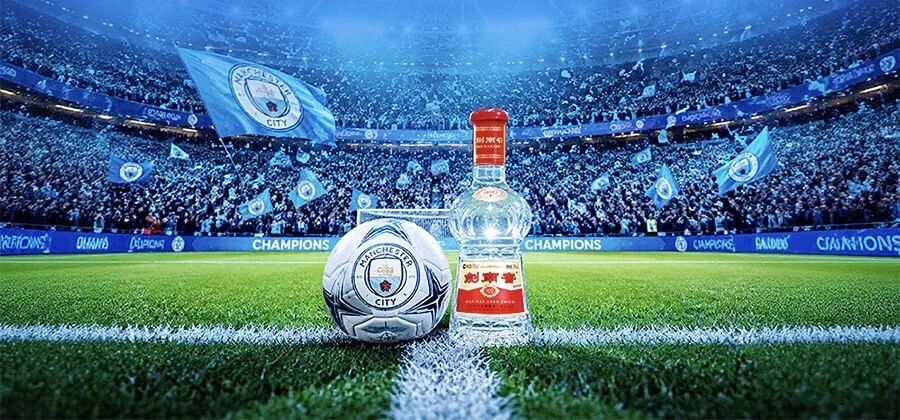
2026年8月1日晚,42826名球迷涌入香港启德主场馆,见证了曼城与国际米兰1比1战平、最终国米点球4比2取胜的跌宕剧本。这是曼城新帅马雷斯卡的首秀,也是塞梅尼奥助攻21岁小将穆巴马破门的高光时刻。看台上的蓝色浪潮与场边的红色酒瓶,构成了这个夏天最具商业意味的体育图景。
但比起比赛本身,更值得玩味的是场边那个熟悉的白酒品牌——剑南春。当绝大多数品牌还在讨论”如何借一场球赛刷存在感”时,剑南春与曼城的合作已经跑完了第七个年头,一笔当初被不少人质疑”值不值”的赞助,正在显现出惊人的时间复利。
2019年的那笔签约,今天才显价值
把时间拨回2019年。彼时的曼城,手里只有3座英超奖杯,欧冠最好成绩是八强,队内没有C罗、梅西级别的全球超级巨星。论历史底蕴,它比不上皇马、巴萨、曼联;论中国球迷基数,它也未必能排进前三。
那一年,剑南春签下了曼城,成为全球唯一白酒合作伙伴。放在当时看,这不是一个”安全”的选择。白酒行业更常见的做法,是押注国家队大赛(如泸州老窖连续多届绑定中国国家队),或者锁定奥运、世界杯这样的全民IP。
但剑南春赌的是”成长型资产”。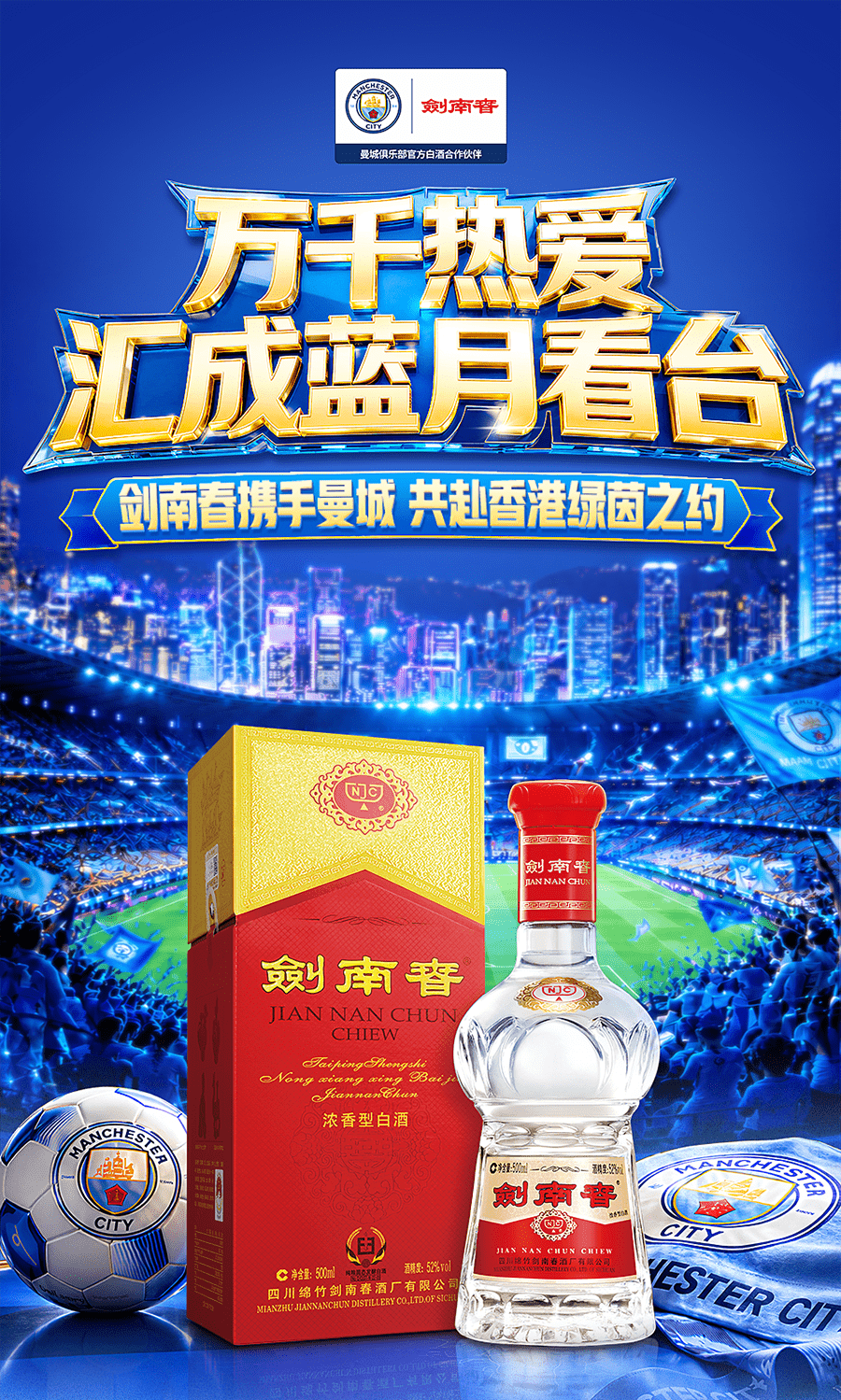
管理学中有个经典概念叫”品牌资产”(Brand Equity),由美国学者Aaker提出,核心观点是:品牌价值不是一次广告投放能堆出来的,它来自长期、持续、一致的品牌联想积累。剑南春2019年押注曼城,本质上是在曼城品牌价值曲线的低位区段买入了一笔长期期权。
后来的故事证明这笔账算对了。自2019年以来,曼城狂揽包括英超、欧冠在内的多项冠军,2023年更是登顶”三冠王”。剑南春不仅全程见证了这一切,还顺势推出了”曼城冠军纪念酒””曼城三冠王纪念酒”等文创产品——限量三万瓶的纪念酒上线即告售罄,体育IP直接转化为了消费市场的硬通货。
对比之下,泸州老窖走的是另一条路:2018年牵手澳网、2021年绑定中国国家队,走的是”大赛+全民”的稳健路线;五粮液、茅台则更多依托传统文化与政务场景。各家路径不同,但剑南春的选择证明了一点:在体育营销里,”提前卡位”比”跟风押注”更需要眼光,也更能吃到时间红利。
从”曝光”到”关系”:白酒体育营销的C端转向
传统体育营销有个老毛病:sponsor(赞助商)把钱砸进去,换一块场边广告牌或一次转播口播,比赛结束,流量归零。业内把这种模式叫”一次性曝光陷阱”——球迷记住了比分,没记住品牌。
剑南春这七年做的,是试图跳出这个陷阱。
此次香港行,剑南春没有满足于场边的那几块广告牌。它在虎扑、懂球帝两大球迷核心阵地发起了”万千热爱,汇成蓝月看台”话题征集,把观赛门票变成球迷互动的奖品;它把助威声浪从线上延续到线下,让手拉旗和横幅成为球迷情感的出口;它还联合抖音打造了《黄家足球班》栏目,让黄健翔与曼城球星面对面聊”冠军的内核”。
这些动作的本质,不是在卖酒,而是在往”情感账户”里存钱。
关系营销理论里有个说法:品牌与消费者之间也存在”情感账户”,每一次正向互动都是存款,每一次生硬广告都是取款。剑南春过去七年持续在球迷社群中做内容、做活动、做联名,实际上是在积累一笔”关系资产”——这笔资产不像硬广那样立竿见影,但它的抗风险能力和长尾效应远超单次曝光。
一个细节很有意思:剑南春此次还邀请了核心合作伙伴亲临现场观赛。这步棋看似是”答谢客户”,实则是在B端复制同样的逻辑——把商业伙伴从”交易对象”变成”共同经历者”,用一场球赛的热血记忆替代一顿商务宴请的客套寒暄。在《WineTime中文网》看来,这种”关系深化”的打法,比单纯的产品推销更能锁定长期合作。
跨界网络的乘数效应:曼城的中国赞助商矩阵
启德体育园外,比亚迪的沉浸式体验区同样排起了长队。这不是巧合——曼城近年来已经聚拢了一个颇具规模的中国品牌矩阵:比亚迪、美的、伊利、剑南春……
单个品牌的体育赞助,影响力受限于自有渠道;但当多个中国品牌共享同一个顶级IP时,事情就变成了另一套逻辑。经济学里有个概念叫”网络外部性”:一个网络的价值,随节点数的增加呈指数级增长。曼城的中国赞助商们,正在无形中构成一个互相引流的商业网络。
剑南春敏锐地抓住了这一点。它借助”曼城共同合作伙伴”的身份,在现场与比亚迪等品牌展开跨界交流。对白酒行业来说,这种异业连接的想象空间很大:白酒的消费场景与汽车、家电、乳制品并不冲突,反而可以通过赛事IP实现用户池的共享。
换句话说,剑南春买的不是曼城的”独家曝光权”,而是一张进入顶级商业网络的入场券。这张入场券的价值,会随着网络中节点(品牌)的增加而持续放大。
《WineTime中文网》认为:体育营销正在进入”关系资产”时代
复盘白酒行业的体育营销史,大致可以划出三个阶段。
1.0时代是”硬广逻辑”:冠名、贴片、场边广告牌,核心是”被看见”。
2.0时代是”内容逻辑”:联名产品、定制节目、球星互动,核心是”被喜欢”。
3.0时代,我们称之为”关系资产逻辑”:品牌不再追求单次曝光的声量峰值,而是追求与消费者、合作伙伴之间持续、稳定、可累积的情感连接与商业网络。剑南春与曼城长达七年的合作,以及此次香港行中展现出的球迷运营、内容生产、异业联动能力,正是3.0时代的典型样本。
值得注意的是,这种模式对品牌的”战略定力”要求极高。它意味着前两年的投入可能看不到直接回报,意味着营销团队要有持续生产内容的能力,更意味着品牌方要把体育IP当作一项长期资产来运营,而不是一次性的营销事件。
从2019年到2026年,曼城完成了从”新贵”到”豪门”的蜕变,剑南春也完成了从”试水者”到”长期主义者”的身份转换。当启德体育园的灯光熄灭,42826人散去,真正留下来的不是那90分钟的比分,而是一个白酒品牌用七年时间攒下的关系资产。
这笔账,越算越明白。
(本文综合公开行业资讯整理,信息/数据来源:懂球帝、新华网、人民网、直播吧、糖酒快讯、新浪财经、搜狐体育、四川在线、火爆好酒招商网等)
【引用资料】
《香港行季前赛,共42826名观众现场观看曼城vs国米》,懂球帝,https://m.dongqiudi.com/article/6116161.html
《2026香港足球盛会打响国际米兰点球大战胜曼城》,新华网,https://www.news.cn/gangao/20260801/80428a10fad57fnative.htm
《2026香港足球盛会启幕国际米兰点球大战胜曼城》,人民网/搜狐,https://m.sohu.com/a/1057830471_120578424
《港媒:曼城8月1日踢完与国米的季前赛后,预计会留港至少2日》,直播吧,https://news.zhibo8.com/zuqiu/2026-07-29/6a69a10fad57fnative.htm
《暌违七载蓝月归来,剑南春与曼城一路同行,书写体育营销新范式》,糖酒快讯,https://www.tjkx.com/main/show/1112199
《剑南春×曼城:两大顶流双向奔赴》,火爆好酒招商网,https://pinpai.9998.tv/xinxi/jiannanchun_146693.html
《从赛场转身到为全民举杯,看泸州老窖的”体育进阶路”》,新浪财经,https://k.sina.com.cn/article_1668899380_63796234019012uk0.html
《白酒跨界营销为何钟情体育圈?》,四川在线,https://sichuan.scol.com.cn/amsc/202405/82531658.html
《携手”四连冠”曼城,剑南春开创跨界合作新高度》,搜狐/网易,https://www.sohu.com/a/782847505_222648
《白酒体育营销案例|体育营销助力泸州老窖品牌焕新》,网易/商业新知,https://www.163.com/dy/article/HGF937MO0529863P.html
Seven years. Manchester City went from a Premier League title contender to a Champions League treble-winning challenger. Seven years. Kai Tak Sports Park replaced Hong Kong Stadium as Asia’s new football landmark. On the evening of August 1, 2026, 42,826 fans flooded into the Kai Tak Main Stadium to witness a dramatic encounter – Manchester City drawing 1-1 with Inter Milan, with the Italian side prevailing 4-2 on penalties. It was the debut of City’s new manager Maresca, and a highlight moment when Semenyo assisted 21-year-old youngster Muamba’s goal. The blue tide in the stands and the red bottles at the touchline painted the most commercially significant sports tableau of the summer.
But more intriguing than the match itself was the familiar baijiu brand at the touchline – Jiannanchun. While most brands are still debating “how to gain presence through a football match,” Jiannanchun’s partnership with Manchester City has already run its seventh year. A sponsorship that was once questioned by many as “not worth it” is now revealing astonishing time-compounded returns.
That 2019 deal is only showing its true value today.
Rewind to 2019. At that time, Manchester City had only three Premier League trophies to its name, a best-ever Champions League finish of the quarter-finals, and no global superstars like Ronaldo or Messi on the roster. In terms of historical prestige, it couldn’t match Real Madrid, Barcelona, or Manchester United. In terms of Chinese fan base, it might not even rank in the top three.
That year, Jiannanchun signed with Manchester City, becoming the club’s exclusive global liquor partner. At the time, this was not a “safe” choice. The more common practice in the baijiu industry was to bet on national team tournaments (such as Luzhou Laojiao’s long-term association with the Chinese national team), or to lock onto mega-IPs like the Olympics or World Cup. But Jiannanchun was betting on a “growth asset.”
There is a classic concept in management called “brand equity,” proposed by American scholar David Aaker. Its core insight is that brand value is not built through a single advertising campaign, but through the accumulation of long-term, consistent, and coherent brand associations. Jiannanchun’s bet on Manchester City in 2019 was essentially the purchase of a long-term option at the lower end of City’s brand value curve.
The subsequent story proved the maths right. Since 2019, Manchester City has swept multiple titles including the Premier League and Champions League, culminating in the 2023 “treble.” Jiannanchun not only witnessed all of this, but also launched cultural and creative products such as the “Manchester City Champions Commemorative Liquor” and “Manchester City Treble Commemorative Liquor” – the limited run of 30,000 bottles sold out immediately upon release, transforming sports IP directly into hard currency in the consumer market.
By comparison, Luzhou Laojiao has taken a different path: partnering with the Australian Open in 2018 and the Chinese national team in 2021, following a stable “major events + mass appeal” route. Wuliangye and Moutai, meanwhile, have relied more on traditional culture and government-affiliated scenarios. Each brand has its own approach, but Jiannanchun’s choice proves one thing: in sports marketing, “early positioning” requires more foresight than “bandwagon betting,” and yields greater time dividends.
From “Exposure” to “Relationship”: The C-End Shift in Baijiu Sports Marketing
Traditional sports marketing has a chronic problem: sponsors throw money at it, get a touchline billboard or a broadcast mention, and once the match ends, the traffic resets to zero. The industry calls this the “one-off exposure trap” – fans remember the score, not the brand.
What Jiannanchun has done over these seven years is an attempt to escape this trap. For the Hong Kong event, Jiannanchun did not settle for those few billboards at the touchline. It launched a topic campaign on Hupu and Dongqiudi, two core fan platforms, under the theme “Countless Passions, Converging into the Blue Moon Stand,” turning match tickets into prizes for fan interactions. It extended the cheering momentum from online to offline, using hand-held flags and banners as outlets for fans’ emotions. It also partnered with Douyin to create the programme “Huang Jia Football Class,” where Huang Jianxiang sat down with Manchester City stars to talk about the “core of a champion.”
The essence of these moves is not selling liquor, but depositing into an “emotional account.” Relationship marketing theory suggests that there is also an “emotional account” between brands and consumers – every positive interaction is a deposit, every hard-sell ad is a withdrawal. Over the past seven years, Jiannanchun has consistently created content, hosted activities, and launched co-branded products within fan communities – in effect, accumulating a “relationship asset.” This asset may not deliver instant results like hard advertising, but its resilience and long-tail effect far exceed those of a single exposure.
One interesting detail: Jiannanchun also invited key partners to the match in person. This move may appear to be a “client appreciation gesture,” but in reality, it replicates the same logic on the B-end – turning business partners from “transactional counterparts” into “co-experiencers,” replacing the polite formalities of a business dinner with the visceral memory of a football match. In the view of WineTime Chinese, this “relationship deepening” approach is far more effective at securing long-term cooperation than pure product pitching.
The Multiplier Effect of Cross-Industry Networks: Manchester City’s Chinese Sponsor Matrix
Outside Kai Tak Sports Park, BYD’s immersive experience zone also drew long queues. This was no coincidence – Manchester City has in recent years assembled a substantial Chinese brand matrix: BYD, Midea, Yili, Jiannanchun, and others. A single brand’s sports sponsorship has influence limited to its own channels. But when multiple Chinese brands share the same top-tier IP, the dynamics shift.
Economics has a concept called “network externality”: the value of a network grows exponentially with the number of nodes. Manchester City’s Chinese sponsors are unconsciously forming a commercial network that generates traffic for one another. Jiannanchun keenly recognised this opportunity. Leveraging its identity as a “common partner of Manchester City,” it engaged in cross-industry exchanges with brands like BYD at the event. For the baijiu industry, the potential of such cross-sector connections is vast: the consumption scenarios of baijiu, automobiles, home appliances, and dairy products do not conflict – they can actually share user pools through the sports IP.
In other words, Jiannanchun did not buy Manchester City’s “exclusive exposure rights” – it bought a ticket into a top-tier business network. The value of this ticket will continue to grow as the number of nodes (brands) in the network increases.
Sports Marketing Is Entering the Era of “Relationship Assets”
Looking back at the history of sports marketing in the baijiu industry, we can roughly identify three phases. Phase 1.0 was the “hard advertising logic”: title sponsorships, commercials, touchline billboards – the core was “being seen.” Phase 2.0 was the “content logic”: co-branded products, custom programmes, star interactions – the core was “being liked.” Phase 3.0, which we call the “relationship asset logic,” sees brands no longer pursuing single-exposure peak volume, but rather sustained, stable, and accumulative emotional connections and commercial networks with consumers and partners.
Jiannanchun’s seven-year partnership with Manchester City, and its demonstrated capabilities in fan engagement, content production, and cross-industry collaboration during the Hong Kong event, are a quintessential example of the 3.0 era.
Notably, this model demands a high degree of “strategic resolve” from the brand. It means the first two years of investment may show no direct returns, it means the marketing team must have the capability to consistently produce content, and it means the brand must treat the sports IP as a long-term asset to be managed, rather than a one-off marketing event.
From 2019 to 2026, Manchester City has transformed from a “new money” club into an “established powerhouse,” and Jiannanchun has likewise completed its own transformation from a “trial participant” to a “long-termist.” When the lights at Kai Tak Sports Park dimmed and the 42,826 people dispersed, what truly remained was not the 90-minute scoreline, but the relationship assets a baijiu brand had accumulated over seven years. The more you calculate, the clearer the maths becomes.
(This article is compiled from publicly available industry information. Sources/Data: Dongqiudi, Xinhua News, People’s Daily Online, Zhibo8, Tangjiu Kuaixun, Sina Finance, Sohu Sports, Sichuan Online, Huobao Haohaojiu Investment Network, etc.)
References:
“Hong Kong Pre-Season Friendly: 42,826 Spectators Watch Manchester City vs Inter Milan,” Dongqiudi, https://m.dongqiudi.com/article/6116161.html
“2026 Hong Kong Football Festival Kicks Off, Inter Milan Beats Manchester City on Penalties,” Xinhua News, https://www.news.cn/gangao/20260801/80428a10fad57fnative.htm
“2026 Hong Kong Football Festival Opens, Inter Milan Defeats Manchester City in Penalty Shootout,” People’s Daily Online/Sohu, https://m.sohu.com/a/1057830471_120578424
“Hong Kong Media: Manchester City Expected to Stay in Hong Kong for at Least 2 Days After Inter Milan Pre-Season Friendly on August 1,” Zhibo8, https://news.zhibo8.com/zuqiu/2026-07-29/6a69a10fad57fnative.htm
“Seven Years On, Blue Moon Returns – Jiannanchun Walks with Manchester City, Writing a New Paradigm in Sports Marketing,” Tangjiu Kuaixun, https://www.tjkx.com/main/show/1112199
“Jiannanchun × Manchester City: Two Giants Meet in a Mutual Embrace,” Huobao Haohaojiu Investment Network, https://pinpai.9998.tv/xinxi/jiannanchun_146693.html
“From the Pitch to Toasting the Nation: A Look at Luzhou Laojiao’s ‘Sports Progression Path’,” Sina Finance, https://k.sina.com.cn/article_1668899380_63796234019012uk0.html
“Why Is Cross-Border Marketing in the Baijiu Industry So Drawn to Sports?,” Sichuan Online, https://sichuan.scol.com.cn/amsc/202405/82531658.html
“Joining Forces with ‘Four-Peat’ Manchester City, Jiannanchun Creates New Heights in Cross-Brand Cooperation,” Sohu/Netease, https://www.sohu.com/a/782847505_222648
“Baijiu Sports Marketing Cases: Sports Marketing Powers Luzhou Laojiao’s Brand Renewal,” Netease/Business New Knowledge, https://www.163.com/dy/article/HGF937MO0529863P.html
原创文章版权归本网所有;转载文章归原作者所有。发布者:酒业时报,转载请注明出处:https://www.thewinetimes.com/gongsi/11960